
Open cell and closed cell
Spray Foam Insulation in Detroit, MI
An air barrier and insulation in one step, sprayed where batts and loose fill come up short.
- Free on-site look before any price
- Written quote with foam type, thickness and R-value by area
- Moisture, knob-and-tube and leaks flagged before anything gets covered
One Material, Two Very Different Products
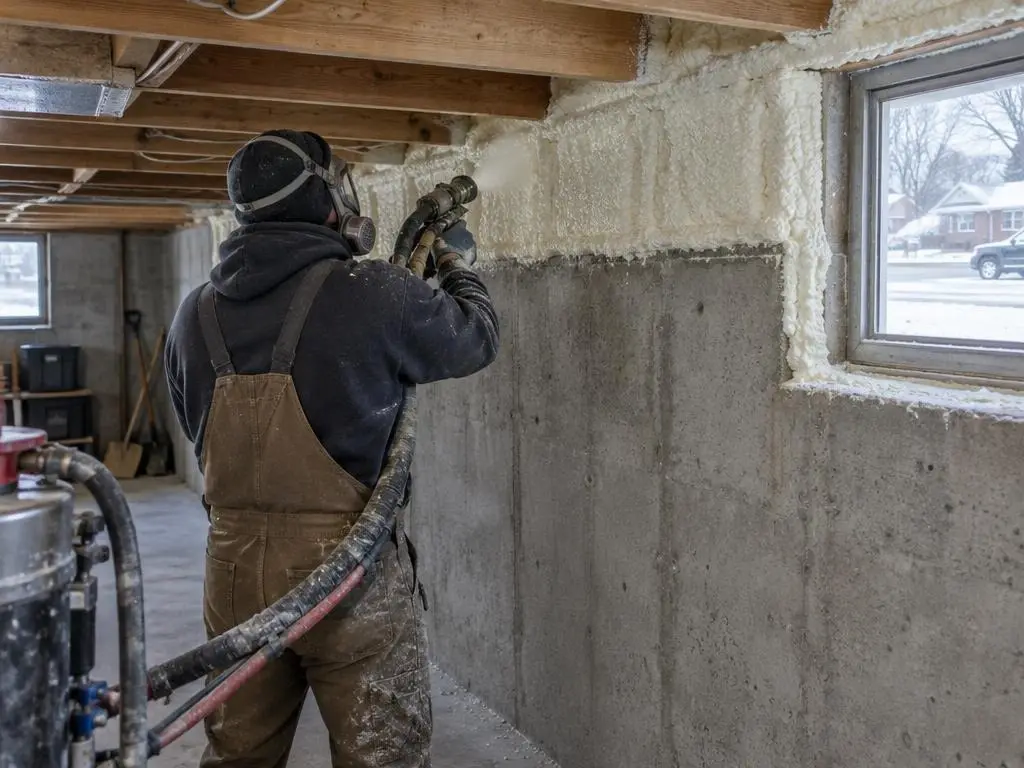
Spray foam insulation is a two-part liquid that reacts and expands as it is sprayed, filling gaps and sticking to wood, concrete and metal. Done right, it stops air movement and insulates in one pass, which is why it works so well in the leaky spots of older Detroit homes: the band joist on top of the foundation, the sloped ceilings of a story-and-a-half, and roof lines with no room for venting.
Open-cell foam
Open-cell foam expands a lot, stays soft, and fills irregular cavities well. HomeGuide lists it at about R-3.5 to R-3.7 per inch. It stops air but lets some water vapor through, so it suits interior spaces, walls in new framing, and roof lines with enough depth to reach the R-value you want. It also dampens sound, which some owners like in walls between rooms or around a home office.
Closed-cell foam
Closed-cell foam is dense and hard once cured, around R-5 to R-7 per inch. At normal thickness it slows vapor and does not absorb water. That makes it the right choice in Detroit basements, on rim joists, under floors above garages, and on roof decks where you need a lot of R-value in a thin layer. It also adds some stiffness to the surface it is sprayed on.
Where spray foam pays off in older homes
In a pre-war Detroit house, the biggest leaks are often places that blown-in insulation cannot seal. The rim joist lets outside air in all the way around the house. Balloon-framed walls can run open from the basement to the attic. Kneewalls in bungalows leave a thin layer of insulation between a bedroom and an unheated attic. Foam closes those paths. On a big open attic floor, by contrast, sealing the leaks and then blowing cellulose usually costs less for the same result, and we will say so.
What happens before we spray
We check for things foam should not cover. Roof leaks need fixing first, since foam on the deck can hide them. Damp framing needs to dry. Live knob-and-tube wiring, which turns up in older Detroit homes, should be evaluated by an electrician before it is buried. Old loose-fill that could be vermiculite gets flagged so you can have it tested. And we confirm whether the space needs a thermal or ignition barrier over the foam, which depends on how the space is used.
Curing and getting back in
Foam gives off fumes while it cures. HomeGuide notes that people are often asked to stay out for 24 hours or more. We ventilate the work area, tell you how long to stay out for the product we use, and walk the job with you when you return.
If you are weighing foam against other options, ask for both on the quote. Get a free estimate
What This Covers
Common spray foam jobs in Detroit-area homes.
Rim and band joists
Closed-cell on the wood band that sits on the foundation, all the way around the basement.
Roof decks and cathedral ceilings
Foam on the underside of the roof where there is no space for vents and batts.
Bungalow kneewalls and slopes
Foam on the sloped ceilings and short walls of story-and-a-half upstairs rooms.
Open walls during remodels
Open-cell or closed-cell in stud bays while the drywall or plaster is off.
Floors over garages and porches
Closed-cell under living space that sits over cold air.
Additions and dormers
Sealing the seams where an addition meets the original house.
Typical Spray Foam Insulation Costs
| Job | Range and source |
|---|---|
| Spray foam, installed | $1.50 to $5.00 per sq ft (HomeGuide) |
| Open-cell / closed-cell | $1.50 to $3.50 / $3.00 to $5.00 per sq ft (HomeGuide) |
| About 1,000 sq ft | $1,500 to $5,000 (HomeGuide); $3,150 to $7,500 in an existing home (Fixr) |
| Existing walls / new construction | $3.15 to $7.50 / $2.75 to $6.50 per sq ft (Fixr) |
| All exterior walls | $4,000 to $10,000 (HomeGuide) |
| Whole house | $8,000 to $20,000 (HomeGuide); $10,000 to $30,000 (Fixr) |
| Typical job minimum | $1,000 to $2,000+ (HomeGuide) |
National ranges from HomeGuide's 2026 spray foam guide and Fixr's 2025 guide, not Detroit quotes. Thickness, foam type, access and prep all move the total. We measure first, and the amount on your written estimate is what you pay.
How a Spray Foam Job Goes
1. Inspect
We look at each space, measure it and check for leaks, moisture and wiring issues.
2. Quote
Each area is listed with foam type, thickness, R-value and price.
3. Prep
Floors and belongings get covered, the area gets masked and ventilation set up.
4. Spray
Foam goes on in passes to the planned thickness.
5. Cure and clean up
The space ventilates, we trim and clean, and walk you through the finished work.
Why Choose Us for Spray Foam Insulation
Foam where it fits
We will tell you when blown-in insulation would do the same job for less.
Thickness in writing
You know how many inches and what R-value each area gets.
Problems flagged first
Leaks, damp wood and old wiring get pointed out before foam covers them.
Spray Foam Insulation Questions
Which is better for a Detroit basement, open cell or closed cell?
Closed-cell. Basement walls and rim joists stay cool and slightly damp, and closed-cell foam resists moisture and slows vapor. Open-cell can hold moisture against cold concrete or wood.
How long does spray foam last?
Foam that is installed correctly and kept dry stays in place for the life of the house. It does not settle the way loose fill can. Problems usually come from roof leaks or plumbing leaks behind it, which is why we check for them first.
Can you spray foam into closed walls?
Standard spray foam needs an open cavity. For closed walls in older homes we usually use dense-pack cellulose or an injection foam through small holes. See our wall insulation page for how that works.
Does spray foam need to be covered?
In living spaces and many attics and basements, foam needs a thermal or ignition barrier such as drywall or a listed coating. The requirement depends on the product and how the space is used. We tell you what applies before we start.
Spray Foam Insulation Service Areas
- Spray Foam Insulation in Detroit, MI
- Spray Foam Insulation in Dearborn, MI
- Spray Foam Insulation in Dearborn Heights, MI
- Spray Foam Insulation in Livonia, MI
- Spray Foam Insulation in Westland, MI
- Spray Foam Insulation in Southfield, MI
- Spray Foam Insulation in Royal Oak, MI
- Spray Foam Insulation in Ferndale, MI
- Spray Foam Insulation in Troy, MI
- Spray Foam Insulation in Warren, MI
- Spray Foam Insulation in Sterling Heights, MI
- Spray Foam Insulation in St. Clair Shores, MI
- Spray Foam Insulation in Grosse Pointe Woods, MI
- Spray Foam Insulation in Hamtramck, MI
- Spray Foam Insulation in Wyandotte, MI
- Spray Foam Insulation in Novi, MI
Get a Spray Foam Insulation Estimate
Ask for foam and non-foam options side by side.